

The main signs fascia boards need replacing are paint that is flaking off, bare grey timber, splits along the board, wood that has gone soft, a gutter that has dropped, birds getting in at the eaves, and damp in the loft. You can spot most of them from the ground. One on its own is worth watching. Several together are a strong sign the timber has had its day.
We are Fletchers Rooflines, a father and son who have fitted more than 750 rooflines around Wakefield. Every photo in this guide is from one of our own jobs, taken before we started. Have a walk round your house with it open on your phone.
What are the signs fascia boards need replacing?
There are seven worth knowing. Each one below has a photo where we have one.
1. The paint is peeling or flaking
This is the early one. Timber fascias are painted, and once the paint goes the wood takes on water. Look for paint lifting in strips or coming away in flakes.
Eurocell, who make roofline boards, put it this way in their own list of warning signs: peeling or flaking paint "could be a sign of a more serious problem". Paint can be redone. If it keeps coming off the same patch, it is worth asking why.
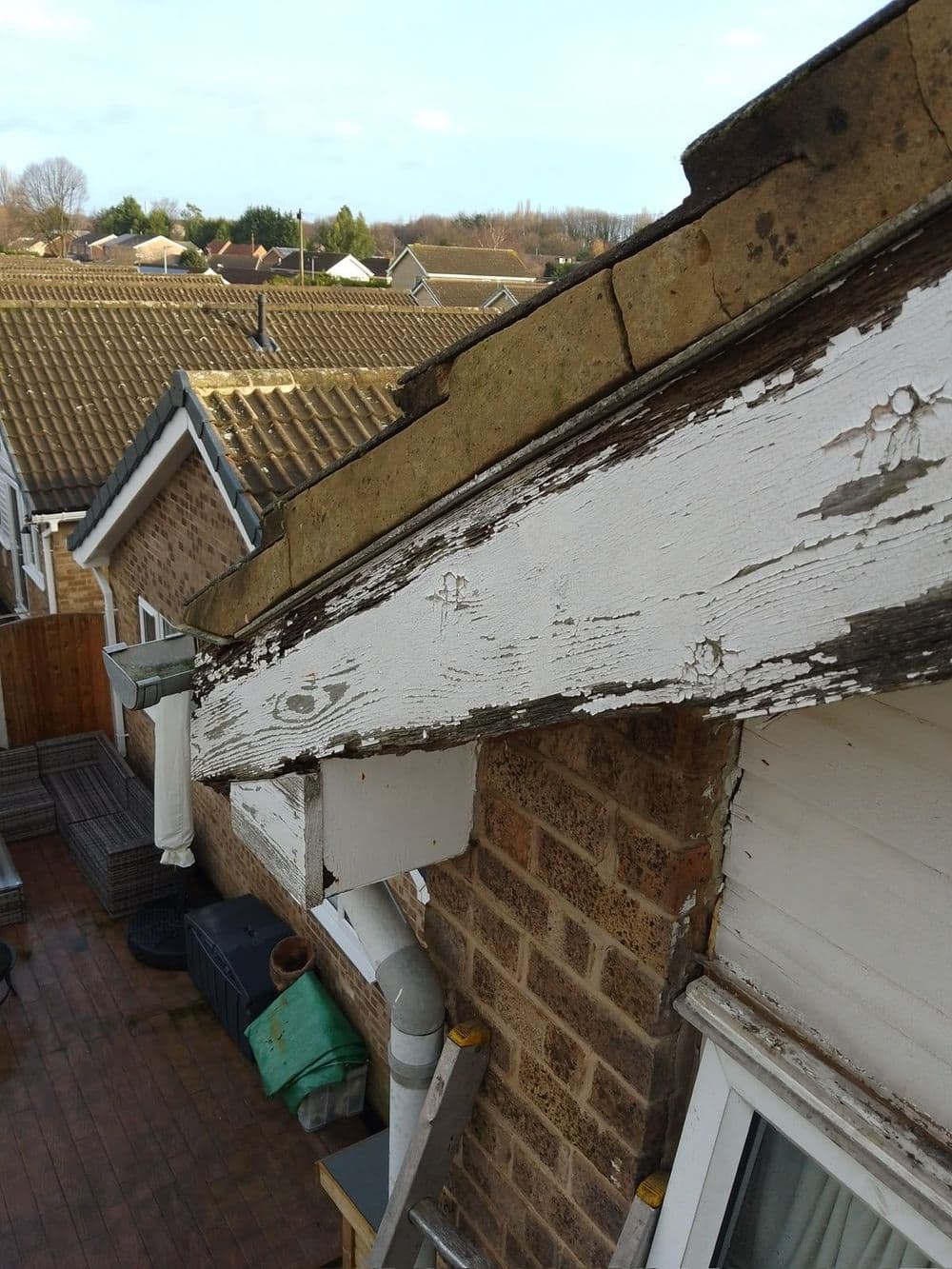
Sign 1. White paint peeling off an old fascia.
2. You can see bare, grey wood
This is what flaking paint turns into if it is left. The paint has gone completely and the timber has weathered to a silver grey, with the grain standing out. At this stage nothing is keeping the rain off the board at all.
Look at the bargeboards, the boards that run up the gable, as well as the fascias. They catch the weather side on, so they are often the first to go.
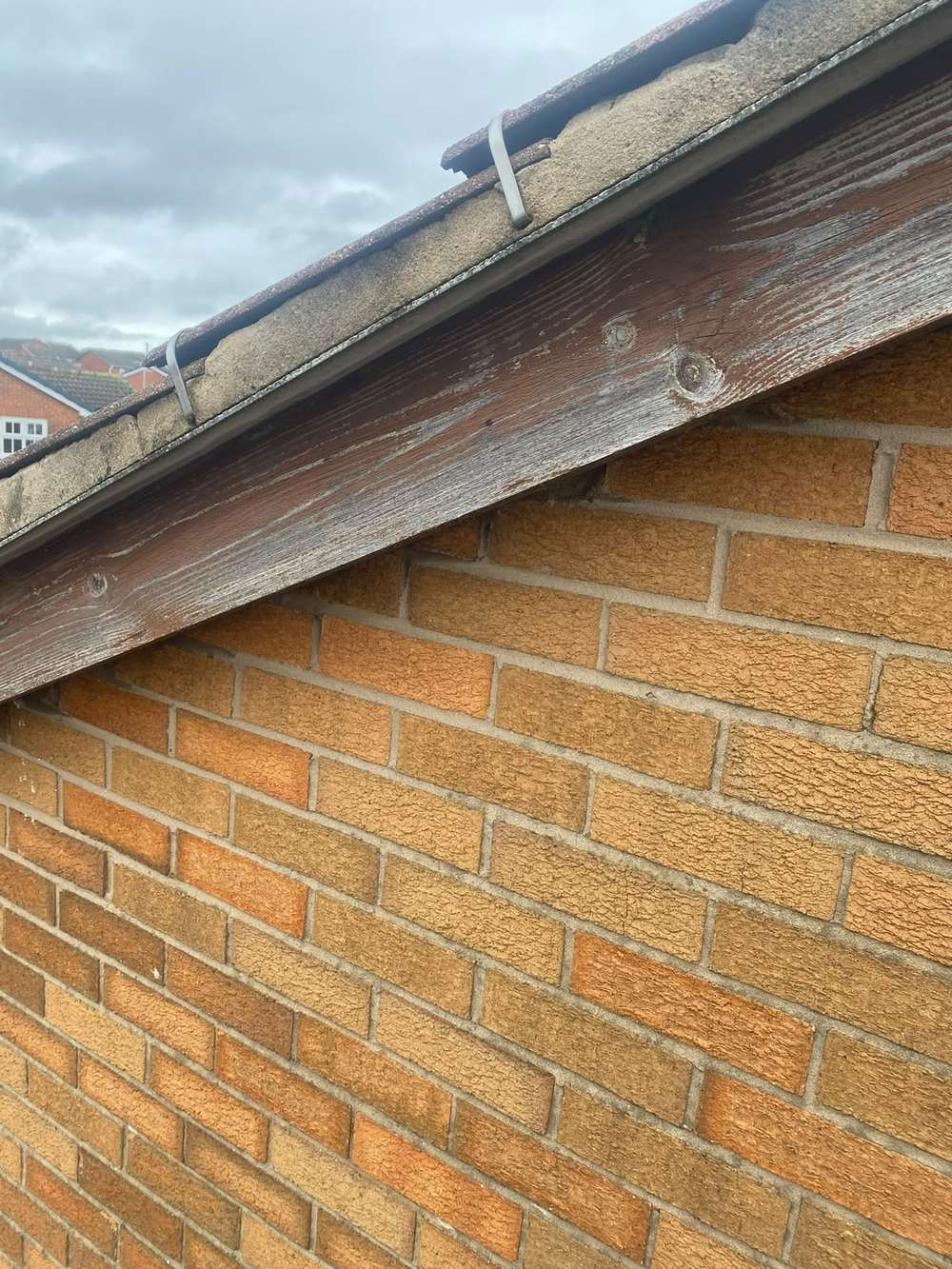
Sign 2. No paint left, and the grain of the timber showing through.
3. The board has split or cracked
Once timber has taken on water it starts to split. You will see cracks running along the length of the board.
A split matters for two reasons. Eurocell's guide says cracks can give pests a way in, and can leave the board "structurally weaker". A split is also one more place for water to get in.
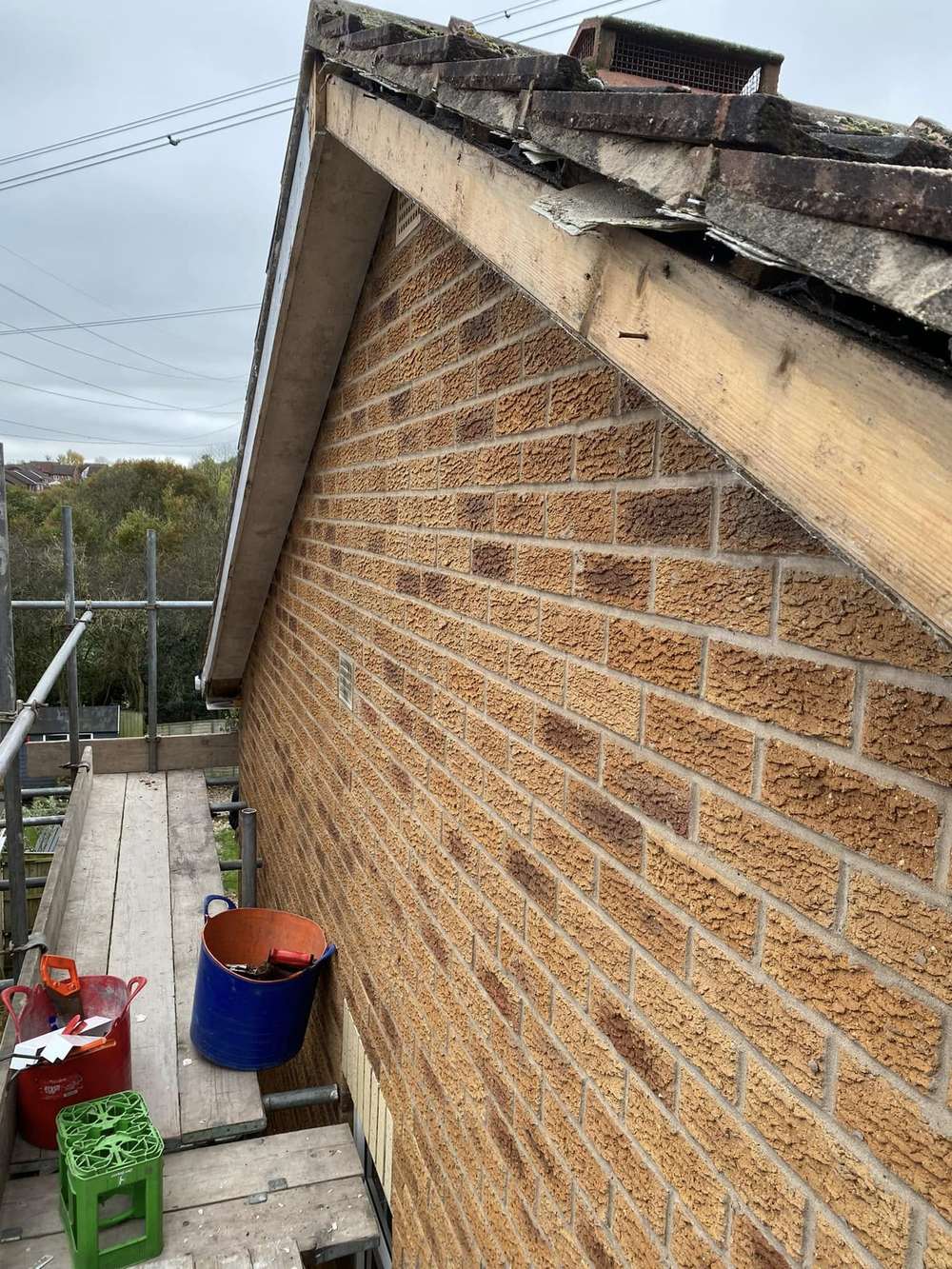
Sign 3. A timber bargeboard that has split along the gable.
4. The wood is soft, crumbling or has dropped
This is rot. Eurocell's test is a simple one: "When you touch it, does it crumble or feel spongy?" If you can reach a board safely from an upstairs window, press it with a thumb. Sound timber does not give.
Do not go up a ladder to find out. Sometimes you can see it from below instead: a corner that sits lower than the rest, or a box end at the corner of the roof that has lost its shape.
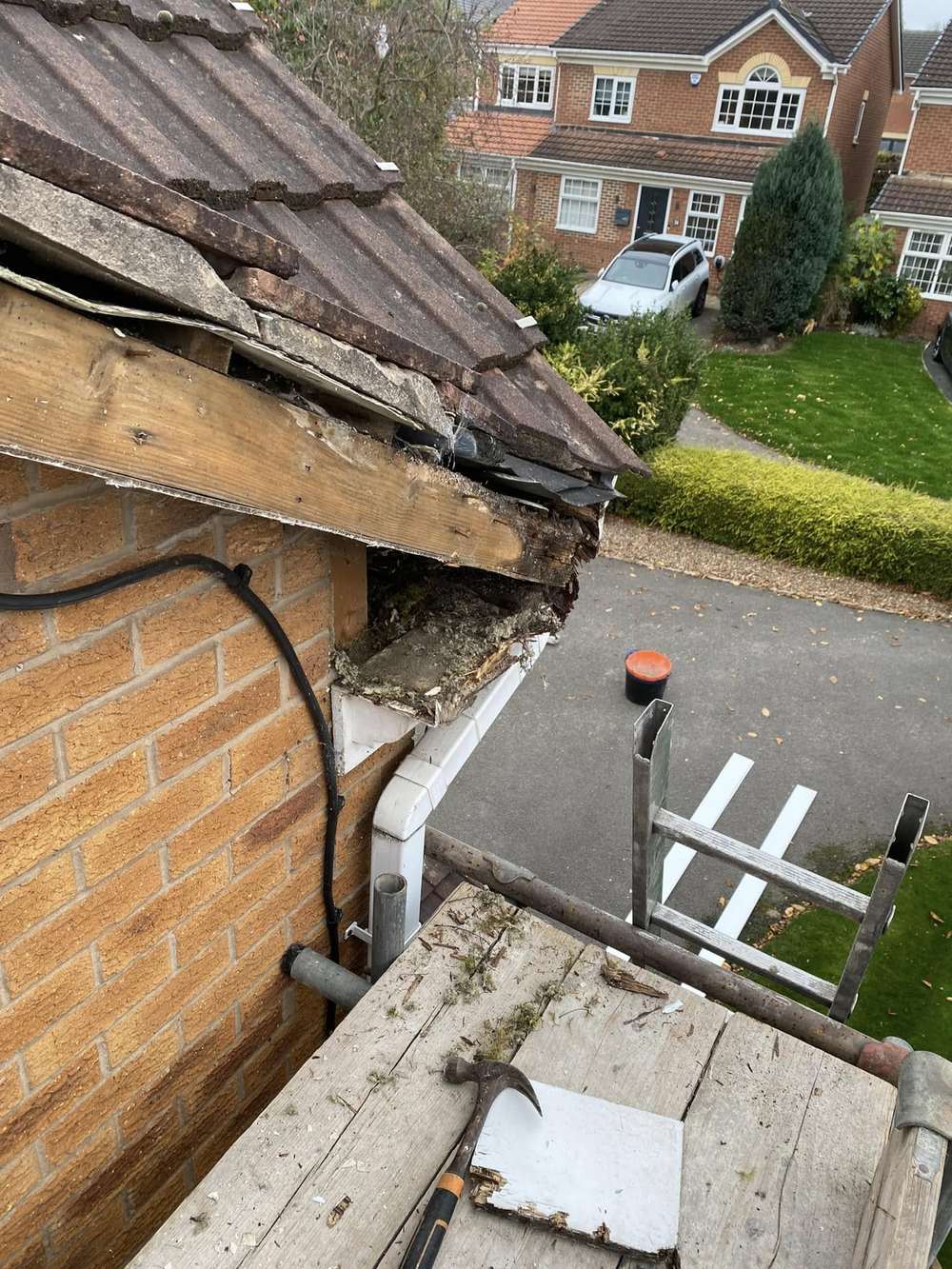
Sign 4. The timber at this corner had rotted through and the corner had dropped.
5. The gutter is sagging or coming away
Your gutter is fixed to the fascia. So when a gutter starts to dip in the middle, tilt forward or pull away from the wall, it is worth asking what it is fixed to.
It may only be a bracket. But brackets are screwed into the board, and a screw in soft wood does not hold. Eurocell's advice on anything at the roofline that is "sagging or loose" is to deal with it as soon as possible, because otherwise "it could snap or fall off". Watch it in heavy rain. Water pouring over the front edge in one place, or running down the wall behind the gutter, tells you where the problem is.
6. Birds are going in and out at the eaves
If you see birds disappearing under the bottom row of tiles, or behind the gutter, there is a way in. Eurocell's guide notes that gaps or holes can let in "pests like birds and insects, or rainwater".
We find the evidence when the old boards come off: nesting material packed into the eaves and into the gutter itself. A gutter packed with a nest cannot carry the water away.
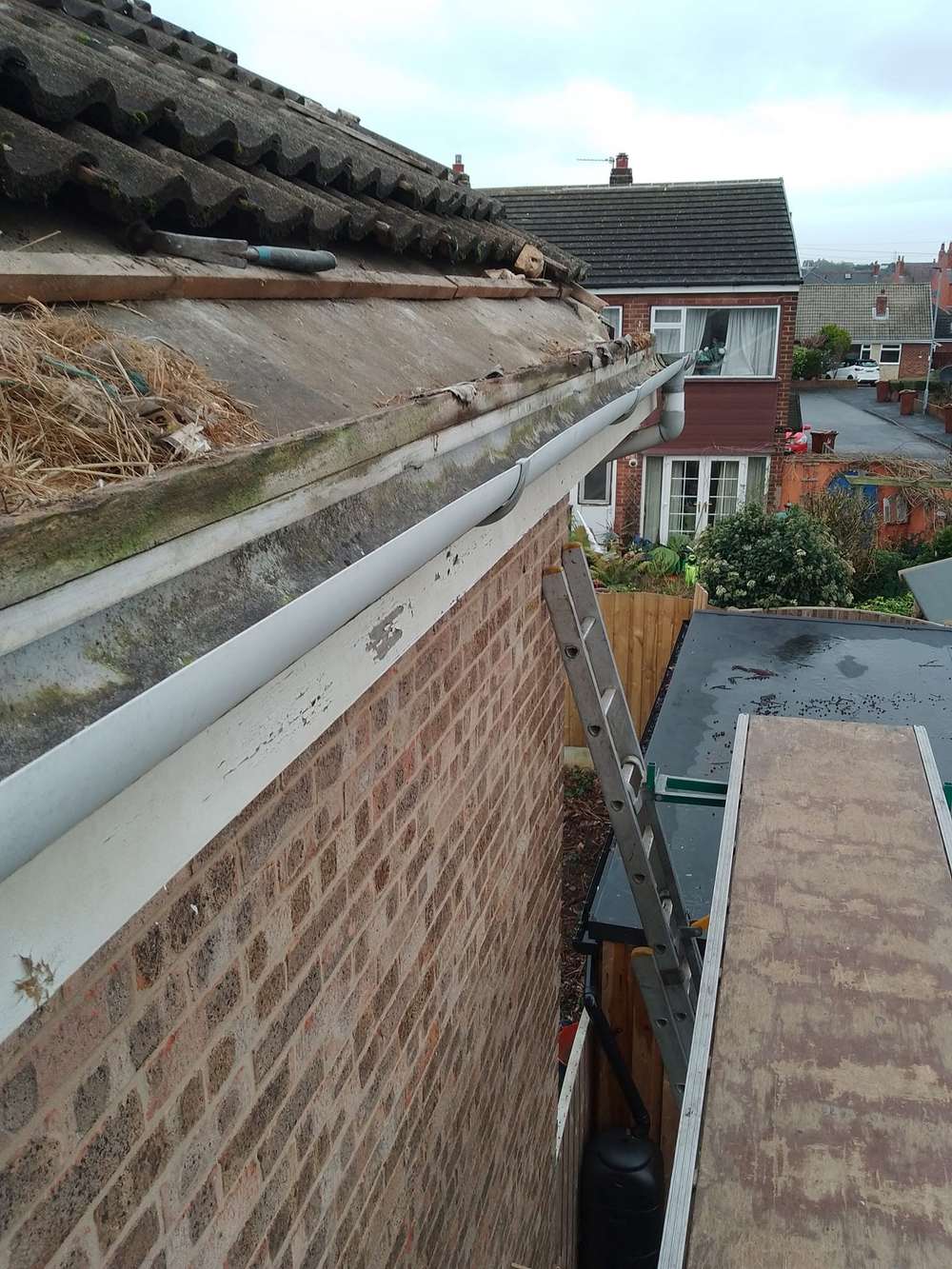
Sign 6. Nesting straw in the eaves, above an old gutter full of muck.
7. There is damp or condensation in the loft
This is the one you find indoors. The soffit, the board under the fascia, is part of how a roof space gets its air. Eurocell's guide explains that when that ventilation is blocked, "moisture can build up leading to humidity and condensation".
If the loft smells musty, or the timbers near the eaves look damp, the roofline is one of the places to check. It is not the only possible cause, so treat it as a reason to have someone look, not as proof.
How many signs before fascia boards need replacing?
There is no fixed number. As a rule of thumb:
- Sign 1 on its own. Keep an eye on it. If the paint has gone in one patch and the wood underneath is hard and dry, you have time.
- Signs 1 to 3 together. The timber has been wet for a while. Get it looked at.
- Sign 4, 5 or 6. Something has already failed. This is the point where a new coat of paint, or a new board fixed over the old one, covers the problem and leaves it there.
Freefoam, another of the big board manufacturers, say full replacement is the better option "when there is any doubt about the condition of the existing timber". We agree. On our jobs the old boards come off and the rafter ends behind them are checked before a new fascia goes up.
What happens if you leave rotten fascia boards?
They do not get better. Eurocell's guide says a damaged fascia or soffit, "if left to fester, can quickly deteriorate", and it is easy to see why from what each part does.
- The fascia holds the gutter. When the board goes, the gutter goes with it.
- The soffit keeps weather and birds out of the roof space. A gap in it lets both in.
- Behind the fascia are the ends of your rafters. The longer wet timber sits against them, the more there is to put right.
None of that happens overnight. It is the reason not to put the job off for another few winters once the signs are there.
How can you check your fascias safely?
You do not need to leave the ground for most of this.
- Walk right round the house. Backs and sides get looked at far less often than fronts.
- Look along the line of the gutter. Stand at one end and sight along it. A dip or a twist shows up straight away.
- Use the zoom on your phone. Take a photo of each run of fascia and zoom in on it afterwards. It is a good deal easier than squinting up.
- Look out of the upstairs windows. You can often see the top of a lower roof, a bay or a porch from there.
- Go out in the rain once. It is the quickest way to see where a gutter is overflowing.
Eurocell suggest looking at least twice a year. After the leaves have come down and again in spring is as good a pattern as any.
What does it cost to replace them?
We publish our starting prices for a full roofline replacement in uPVC, which is fascias, soffits, guttering, downpipes and dry verge:
- Terraced house: from £1,050
- Semi-detached house: from £1,850
- Detached house: from £3,750
How long the run is, how high the house is, the access, and how far any rot has gone all move the figure, so yours is priced once we have seen it.
What should you do if you have spotted some of these?
Take a few photos and send them to us. Our quote form takes up to five, and we look at the house, in person or from your photos, before we give you a price. Quotes are free, with no obligation.
If you would rather talk it through, ring Richard on 07835 889248, Monday to Friday, 8am to 4pm.
Our fascias and soffits page shows what a replacement involves, the prices page explains what moves a price, and there are more photos like the ones above, with the finished jobs beside them, on our before and after page.